



AI-Ready Data Centers vs Traditional Data Centers Explained
As the AI boom reshapes industries, data center infrastructure is changing fast. Teams that manage data center IT infrastructure need new plans for power, cooling, storage, and network links.
Traditional data centers have long given stable space for servers and storage. But AI data centers are changing how we plan compute, storage, and networking.
That shift affects private builds, data center colocation sites, and mixed data center and colocation models. It also pushes data center infra teams to rethink layout, density, and growth.
Traditional Data Centers: Tried and Tested
Traditional data centers are built for CPU jobs that are steady and easy to predict. They fit general-purpose computing, but they are not built for AI speed or high rack power.
Traditional data centers house servers, storage systems, networking gear, and cooling infrastructure. These sites are made for work that is predictable, incremental, and less power hungry.
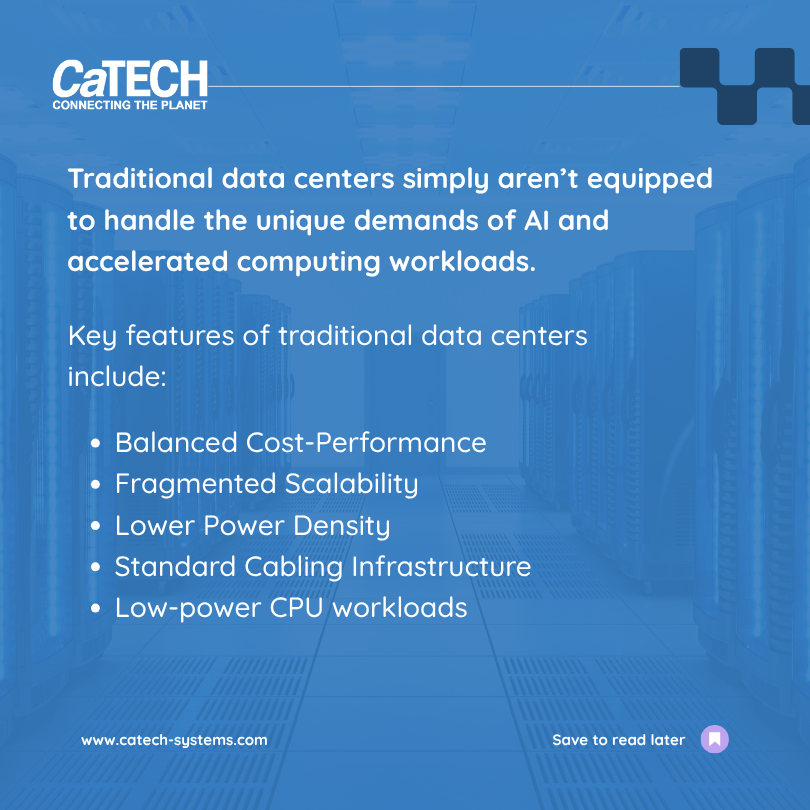
Key features of traditional data centers include:
- Good cost and performance: Designed for general-purpose computing with cost efficiency in mind.
- Slow growth: Resources can scale as apps grow, but not fast enough for AI.
- Low rack power: Traditional racks use about 5-10 kW per rack, and air cooling is often enough.
- Standard cabling: A leaf-and-spine cabling model supports steady network traffic without the bandwidth needs of AI.
- Low-power CPU jobs: CPU-based work uses far less power than AI workloads, which need custom support for high capacity, on-demand performance, and special hardware.
Traditional data centers are simply not set up for the heavy load of AI and fast computing workloads.
AI Data Centers: Built for the Future
As AI grows, specialized AI data centers are rising. These sites are built for high-performance computing, fast networking, and stronger cooling.
Unlike traditional sites, these facilities are designed for heavy AI workloads from the start. That means more power, denser racks, and tighter control over heat.
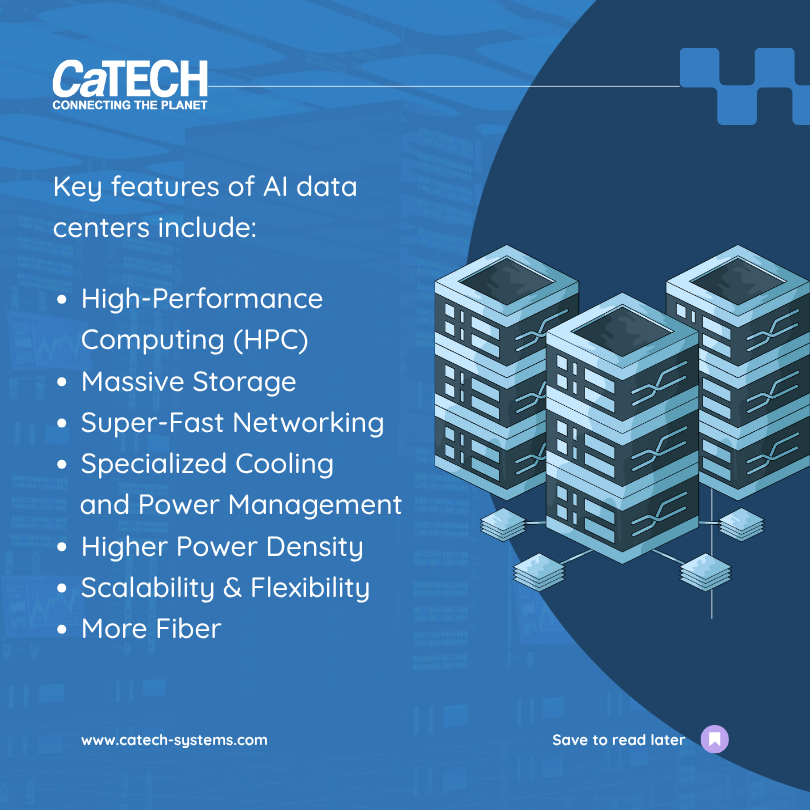
Key features of AI data centers:
- High-performance computing (HPC): Powerful systems with GPUs, FPGAs, and ASICs handle large AI jobs. AI workloads also rely on GPUs, TPUs, and NPUs for parallel work and heavy data crunching.
- Huge storage capacity: AI apps create vast amounts of data, so they need storage with very high capacity and throughput. This often means requiring hybrid storage with fast SSDs and distributed architectures.
- Very fast networking: Low-latency Ethernet and InfiniBand move data quickly between compute nodes and storage systems.
- Cooling and power control: AI hardware is dense and power hungry, so liquid or immersion cooling is often used to keep heat under control. Direct-to-chip cooling and immersion cooling help manage heat from tightly packed GPU racks, while smart power management keeps energy use efficient.
- Higher rack power: AI servers can use 5-10x more power than traditional systems, often reaching 40-110 kW per rack.
- Growth and flexibility: Because AI changes fast, AI data centers often use modular layouts, containerized deployments, and software-defined infrastructure for easier change.
- More fiber links:
AI servers need 4-5x more fiber links, which is why multimode fiber and active optical cables are common for fast, low-latency communication.
To handle AI, existing data center hardware and layouts must be updated.
- Updated hardware: Servers, switches, cables, and storage must handle large amounts of real-time data.
- Reworked network backbone: Higher bandwidth is needed so GPU racks and storage systems can communicate efficiently.
- Rebuilt design elements: Cooling, power, and cabling systems need to support higher density and better connection.
Why AI workloads need different cabling
Traditional data centers use a leaf-and-spine model for cabling, and that works well for standard jobs. AI workloads need a more specific design because they move far more data and need more compute.
AI servers rely on high-performance GPUs that need smooth connection to work as one system.
This increases the need for:
- High-density fiber links: Up to 4-5x more than traditional setups.
- Multimode fiber for short runs: Useful for intra-rack and inter-rack cabling, with speeds up to 400Gbps.
- Active optical cables: These help simplify installs and support fast data transfer.
Key Differences: Traditional vs. AI Data Centers:
- Chip needs: AI workloads run on GPUs, TPUs, and NPUs built for extreme performance. Traditional CPUs are general-purpose chips that handle many tasks at average levels.
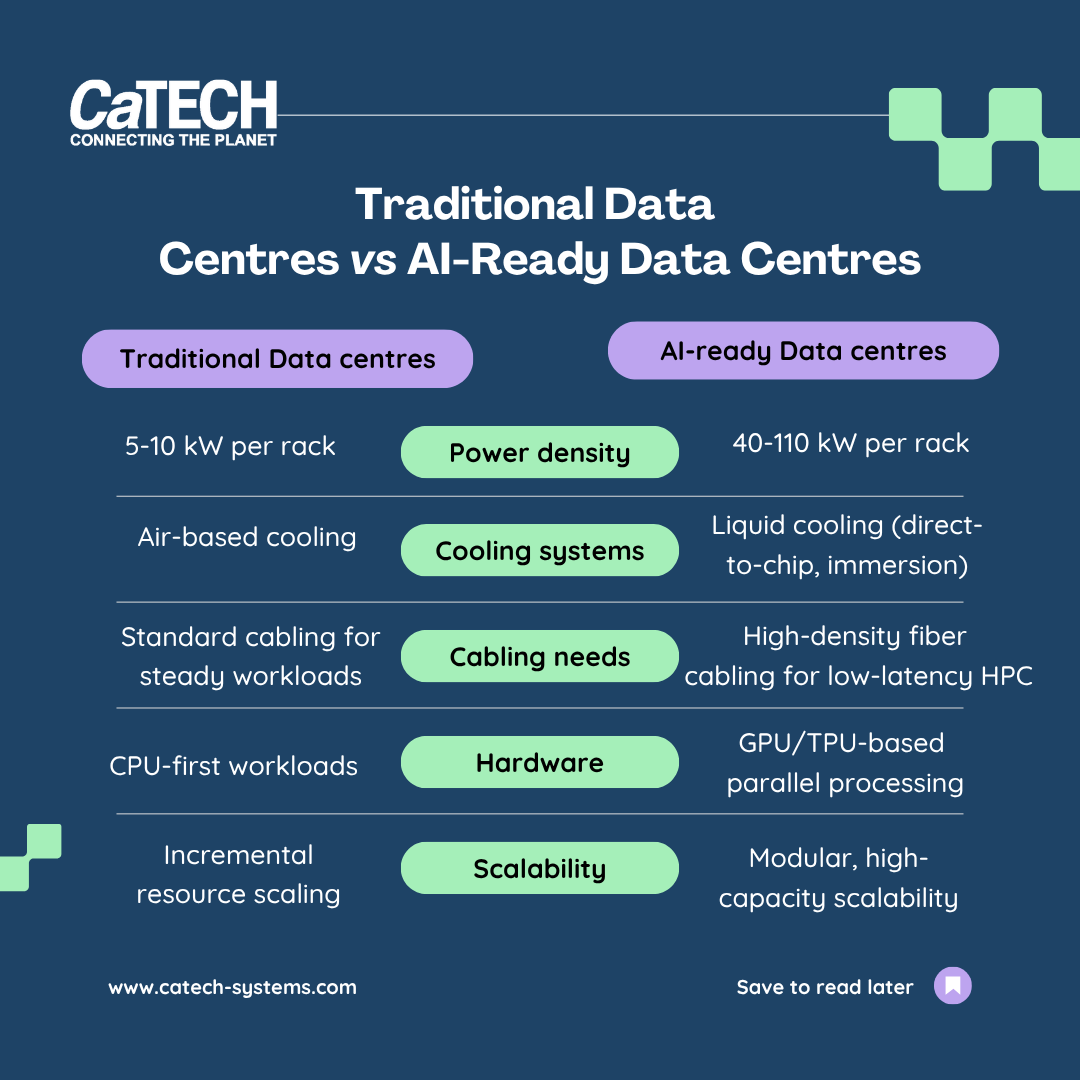
- Power supply: AI-driven data centers need much more power, often 40-110 kW per rack, compared with 10-12 kW per rack in traditional data centers. Some systems even plan for power levels beyond 200 kW per rack.
- Cooling systems: Traditional air cooling is less efficient for AI. AI data centers use liquid or hybrid cooling, which works better in high-density spaces and helps control heat from powerful hardware.
- Cabling systems: AI servers need far more fiber links than traditional servers. A new cabling layout is needed to cut latency and support better performance.
- Design changes: AI-ready infrastructure is now essential for many businesses that want to stay competitive.
QUICK COMPARISON TABLE: TRADITIONAL DATA CENTRES VS AI-READY DATA CENTRES
The Future of Data Centers
As AI keeps driving change, we will see more specialized AI data centers. These sites will push performance and efficiency higher.
Traditional data centers will not disappear. Many organizations will use a hybrid plan, mixing standard systems with AI-ready infrastructure to meet different needs.
For data center and colocation teams, the goal is the same: build for growth, power, and lower latency. Whether a company runs its own data center infrastructure or works with a data center colocation provider, AI is forcing better planning. That is why data center infra budgets now include more fiber, better cooling, and stronger power delivery.
If you think AI is just a trend, think again. It is now driving a real shift in how businesses run.
From training large language models like ChatGPT to running live AI apps, these workloads need infrastructure that traditional data centers cannot handle.
As Canada's leader in data center cabling solutions, CaTECH Systems is at the front of this change. The company helps businesses build the data center infrastructure they need for next-gen sites.
Q&A
Question: Why can't traditional data centers simply run AI workloads without major upgrades?
Short answer: Traditional data centers are built around predictable CPU jobs, low rack power, standard cabling, and air cooling. AI workloads depend on GPUs, TPUs, NPUs, faster networking, more storage throughput, and advanced cooling. Without those upgrades, a traditional site struggles with AI's dense and fast-moving demands.
Question: What makes cabling so important in an AI-ready data center?
Short answer: AI systems often need many GPUs to work together as one coordinated compute platform. That requires fast, low-latency links between servers, storage, and compute nodes. AI data centers may need 4-5x more fiber links than traditional sites, plus multimode fiber and active optical cables for short-distance transfers up to 400Gbps.
Question: How much more power do AI data centers usually require?
Short answer: AI-ready data centers can need far more rack-level power than traditional facilities. The text notes that standard racks often use around 5-10 kW per rack, while AI sites can reach 40-110 kW per rack, with some designs looking beyond 200 kW per rack. This comes from dense GPU systems and the need for parallel processing.
Question: Will AI-ready data centers replace traditional data centers entirely?
Short answer: No. Traditional data centers will still matter for many general workloads. Most organizations are likely to use a hybrid approach, keeping traditional infrastructure for steady tasks while adding AI-ready infrastructure for training, inference, and other fast computing needs.
RELATED LINK: The Future of Data Centers: Key Trends Shaping the Industry